


Q. Do you know approximately how many authors there are across the industry with 500,000 units or more during this four-year period?
A. My understanding is that it was about 50.
Q. 50 authors across the publishing industry who during this four-year period sold more than 500,000 units in a single year?
A. Yes.
— Madeline Mcintosh, CEO, Penguin Random House U.S.
In her viral post, No One Buys Books, Elle Griffin painted a pretty bleak picture of the state of the publishing industry. Her article was based on congressional testimony by Penguin Random House. In 2022, Penguin wanted to buy Simon and Schuster. The government wanted to block the acquisition because it would have created a major monopoly (why isn’t anyone stepping in to block the Netflix acquisition? Nobody knows).
According to Griffin, “The DOJ’s lawyer collected data on 58,000 titles published in a year and discovered that 90 percent of them sold fewer than 2,000 copies and 50 percent sold less than a dozen copies.”
Yikes. That’s a pretty bad deal.
In James Mariott’s article “The Dawn of Post-Literate Society,” he says:
“In America, reading for pleasure has fallen by forty per cent in the last twenty years. In the UK, more than a third of adults say they have given up reading. The National Literacy Trust reports “shocking and dispiriting” falls in children’s reading, which is now at its lowest level on record. The publishing industry is in crisis: as the author Alexander Larman writes, ‘books that once would have sold in the tens, even hundreds, of thousands are now lucky to sell in the mid-four figures.’”
I am not going to repeat what’s been written about in a thousand other places, but suffice it to say, there are a lot of people who want to be writers but not a lot of people who want to be readers.
I, myself, don’t really read books that have been published in the last five years. Of the 20 or so books I read in 2025, only six were modern and only three were published in 2025. And I am one of those people who would be proud to call myself a reader.
So, statistically, even though there are counterarguments, it’s pretty much undeniable that not many people are reading books any longer; they’re not buying them, or if they are, they’re buying books like The Let Them Theory or It Ends with Us. So not only are you probably not going to make any money on your novel, but there’s a high probability that only 12 people will buy it.
This calls into question who we’re actually writing for. There are over 300 MFA programs in the United States. Let’s just say the average length of a program is 2 years (I am making this up, but they range from 1-3 years) and let’s pretend the average cohort is 20 people (again, this is a guestimation). That means that every year 6,000 people are leaving MFA programs, precious first drafts of novels in hand, trying to make it! Compare that to the 50 writers who sell more than 500,000 copies of a book in a year.
I am not suggesting that this time in an MFA program is wasted time or money (although, given the current political climate, student debt is a precarious thing). Doing what you love, and striving to do it well, is a beautiful thing, and quite possibly one of the most important things we can do with our lives.
BUT I do think there needs to be a collective reality check. If you’re writing for any of the two reasons I posted in the beginning:
Money
Validation/attention
You’re most likely not going to get either. So, what’s the point? Why write?
Keep your heart open
I am about to paint a very unflattering picture of myself; brace yourselves. I went to an arts magnet school in Denver, so when I arrived at college and was told I had to take the introductory creative writing course, I, of course, said no way! In high school I majored in Creative Writing. But the Dean of the college English department was firm. I couldn’t be an English major if I hadn’t taken the intro class. So I decided not to major in English, and instead majored in Latin American Studies.
During college, I was an ally for our LGBTQ club. LOL! So, as an ally, I helped with their events. In my sophomore year of college, 2009, we hosted a young poet named Andrea Gibson. By then, I had taken more English courses than Latin American Studies courses, but I still hadn’t taken creative writing classes. (By the time I got around to taking writing classes, I was a junior, and I had wasted so much time! And it turned out, the intro to creative writing course was the best writing course I took at school.)
I just wanted to paint a picture of the snob I was volunteering as an ally for an Andrea Gibson performance. I remember thinking I didn’t like their literary style. I think I probably would have used the word “basic” if that had been in our cultural vocabulary back then. Where was the dazzling syntax and language?! But after they were done, our small crowd went crazy for them. Absolutely nuts. The little queers and allies in that room LOVED them. I am sure at the time I was a little indignant about this. There are still a lot of literary folks out there who throw a ton of shade on Andrea Gibson. A lot of poets, like little snobby Sammie, think they didn’t have a strong handle on poetic craft.
A lot of years have passed since 2009. Thank GOD. And I now feel so sad for little snobby Sammie. I see her as a little insecure nineteen-year-old who held onto craft and skill and literary cultural expectations to bolster her self-esteem.
In my little world, there wasn’t enough room for all of us artists, so I had to be better, and to be better than meant I had to make others less than.
I have since fallen in love with Andrea Gibson. I watched them read in 2017, and it was the same experience: the crowd was in their thrall. What is it about Andrea Gibson that captures so many people? Especially so many non-poets?
In the documentary Come See Me in the Good Light, they say:
It was always important to me to always write poetry that people wouldn’t need a degree to understand . . . Why write a poem that’s over somebody’s head? Even more than that, over somebody’s heart?
When you watch Andrea perform, you get the sense that they’re speaking from a place that feels genuine. It feels real. There is no artifice. And that resonates with people. They were one of the blessed few bell hooks talked about, blessed to be economically self-sufficient, doing what they love.
Who is to say if Andrea would have continued making poetry if they hadn’t made a living at it? We will never know. But I get the feeling that they would have. Their work feels as if it’s springing, unadulterated and free, from their soul. There’s a word that describes this:
In Indian aesthetics, a rasa (Sanskrit: रस) literally means “juice, essence or taste.” It is a concept in Indian arts denoting the aesthetic flavour of any visual, literary or musical work that evokes an indescribable feeling in the reader or audience. It refers to the emotional flavors/essence crafted into the work by the writer or a performer and relished by a “sensitive spectator” or sahṛdaya, literally one who “has heart” and can connect to the work with emotion, without dryness.
I’ll get into this more in an interview next week, but the idea is that when you create art, you can imbue your work with a sensation that can be experienced by a witness with an open heart.
If you have an open heart, Andrea’s work tastes different.
Unpopular opinion coming right up: I recently read All The Way to the River by Elizabeth Gilbert. For context, the only other book I have read by her was Big Magic, which I enjoyed. My girlfriend gifted me All the Way to the River for my birthday, and I avoided reading it because I had, vaguely, heard negative reviews. Which is one of the reasons I hate reviews.
(I could write a whole other article about HOW NASTY the literary community is. All these evil take-downs of people. As if the world wasn’t harsh enough! But it’s like some weird popularity contest: let’s see who can trash Ocean Vuong or Miranda July. Let’s see who is smart enough to take down Jia Tolentino. If I could do away with reviews, I would. Ultimately, it’s the reader who gets to decide whether a book is for them or not, and the rest are a bunch of pretentious taste-makers trying to get respect through other people’s creativity. Okay, end rant.)
When I picked it up, I could tell that this book was intended for a very specific type of reader. A reader like me—a reader in a program. I have no idea what it would be like to be someone who is not in some sort of recovery program and read All the Way to the River, but as someone in ACA, I can tell you that I felt deeply seen, and I admired Elizabeth Gilbert’s ability to take us there. I cried in the bathtub. And I ultimately left with a sense that I was not alone.
After I finished the book, I started to read some of the reviews, and then just wanted to throw my phone across the room. Sure, could I have lived without her poems and drawings? A hundred percent. Was it a little melodramatic at times? For sure. Did I care? Not at all. Because ultimately, the book opened the door to a room and let me feel something I needed to feel. It had flavor. I could taste it.
Is All the Way to the River a book for everyone? Nope. Is it for most people? I have no idea how many people are walking around who could use some help for co-dependence, addiction, or recovery of some kind, but I am guessing a lot. But does that mean they want Liz Gilbert to deliver this message? Not necessarily.
Liz Gilbert obviously doesn’t need the money for this book, and she’ll be published again even though this one was a flop. But I don’t care about this book’s market value. I just care that it made me feel. And that feeling, that flavor, can be created even if only 12 people bought her book—even if it’s just Liz Gilbert’s mom who read the book. That feeling goes beyond labor value and into something more akin to deep, sacred attention.
Rasa, this sacred flavor, is what the artist feels when making art. This feeling, then, is infused into the art itself. And then the person who views the art experiences that same feeling. This means that there is something spiritual being exchanged between two people. Something that transcends the physical realm. You don’t have to know the person who made the art; they could be dead! But the rasa is still there.
As I mentioned before, I have clung to art as a way to feel that I am somehow above the system. If I am an artist I am somehow above the fray, I am not a member of the working class, I am not doomed to sell my soul to the corporate devil. I am special! But rasa demands connectedness.
Instead of being above someone, rasa allows me to be with someone.
I have felt this connectedness in my life; when I read The Heart is a Lonely Hunter by Carson McCullers at fifteen, when I watched Jonsi perform in Chicago, when in a dark theater I watched Cinema Pardiso. In those moments there was no me, there was no McCullers, there was no Jonsi, there was simply us.
Bruce Springsteen and the magic of connectedness
Allow me to tell a story to prove a point. One of my most profound memories as a young person was a cold December morning. I was a senior in high school and I’d inherited my mother’s green VW Beetle. My sister was a freshman at my school so we’d drive to school every morning. This particular morning we were listening to a mixtape that our dad had made. The first song on the tape was Born to Run by Bruce Springsteen. As we were pulling closer to school at 7 in the morning, we could see that the full moon from the night before had not yet set and it was there, right in front of us, like a magical, glowing orb, refracting the light of the rising sun. The effect of the moon and Springsteen was like nothing I’d ever experienced before. I felt as if an inner charge inside of me was hooked up to the entire universe and the blood in my veins was fire. Frankie and I didn’t say anything to each other but we knew we had to chase the moon. We were a half an hour late to school. We rewound Born to Run over and over again and drove through the streets of Denver until the moon passed out of our sight.
I’ve always loved Bruce Springsteen. I totally identify with that kid in the film, Blinded by the Light, a British teen of Pakistani descent, who falls in love with Springsteen. In the film he says, “I feel it all right here. It’s like Bruce knows everything I have ever felt, everything I have ever wanted.” There’s something so emotionally true in Springsteen’s songs that Javed, my sister, and I all felt so seen by his music.
I recently watched the movie, Deliver Me From Nowhere, which was about Bruce Springsteen making the album Nebraska. It was not the best movie in the world, but I loved it all the same because I learned that Bruce Springsteen’s dad was a bipolar addict, just like my dad. It made so much sense why the agony of those songs felt like they were mine, not Springsteen’s. And, in a way, they were. In the film (based on a book), Bruce Springsteen, records a series of songs in his bedroom. He wants to put his demos on a record just as they are, and it creates a lot of tension because Bruce is riding high on some of his big songs and selling out all sorts of tours, and now he wants to put out a super dark, super sad, poorly recorded album, and everyone is worried that he’s out of his mind. Not only does Bruce want to put out this album but he also doesn’t want to do a tour or explain it in interviews. Today, this would never happen. But back then, his manager says, “In this office, in my office, we believe in Bruce Springsteen.” And what a loss it would have been if he hadn’t believed in Bruce Springsteen! Nebraska has one of my favorite songs of all time, Atlantic City.
What makes Bruce Springsteen special, and why Frankie and I couldn’t stop playing Born to Run while chasing the moon, was because Bruce wasn’t trying to be above us. He was with us.
“Oh baby this town rips the bones from your back, it’s a death trap. We gotta get out while we’re young, because tramps like us baby we were born to run.”
For that moment, there was a tripartite soul: Bruce, Frankie, and me.
I don’t think when Bruce Springsteen recorded those demos in his bedroom, he was thinking about money, or the market, or the attention and fame that would come with a bestselling album. I think he was just connected to art in a pure, open way. We don’t do this anymore. We’re rushing books through so we can get to the next advance, we’re churning out substack content so we can meet our quotas and get subscriber money.
Elena Ferrante says in an interview with Sheila Heti, “I remain of the opinion that a book has to absolutely make it on its own; it shouldn’t even use advertising.” This is a pretty intense opinion. But I think what she’s implying is that marketing cheapens the connective quality of art itself. It changes the rules of engagement for a work of art. Instead of being a place where three souls genuinely meet: the art, the artist, and the witness, it becomes a little bit of coercion.
We’ve forgotten that through our attention to both making art from a deep and genuine place and also witnessing it with an open heart, we can, for a moment, transcend separateness.
We can escape the pain and suffering of our aloneness, we’re so desperate to alleviate, not through avoidance but through acceptance.
Art and Love let you lose your skin
I’ve been asking the people around me why they’re married, and why they love each other, for an inappropriately long time. If you’re my friend and I have subjected you to this line of questioning, I wish I could tell you I am sorry, but unfortunately, this is just who I am. So instead, I will say thank you. But once, in high school, I asked my friend’s parents why they stayed together. They’d dated for six weeks before getting engaged. They’ve been married for over forty years. My friend’s mother said, “You know, it’s hard. Sometimes one of us is up, and the other one is down. Then it’s the other way around. This can go on for years. But sometimes you’re both in the same place at the same time, and it’s magic. We’re together for those times.”
When I was a kid, I thought this was a very depressing answer. How could I possibly stay in a relationship with someone who wasn’t in the same emotional or intellectual place as me for years at a time?! How could I possibly handle the loneliness of being in a separate world from my partner?
Now, though, I understand what she meant. It is a rare gift to be on the same emotional plane as someone else at the same time, let alone your partner. I think that’s what makes movies like Lost in Translation so transcendent. They speak to those moments of strange togetherness when there’s a liminal space between me and you and the world, and everyone occupies that radiant space together at the same time. Love, either romantic or familial, is how we enter that space with the people closest to us.
Art helps us do that for the world.
My sister, Frankie Downing, and a life of art
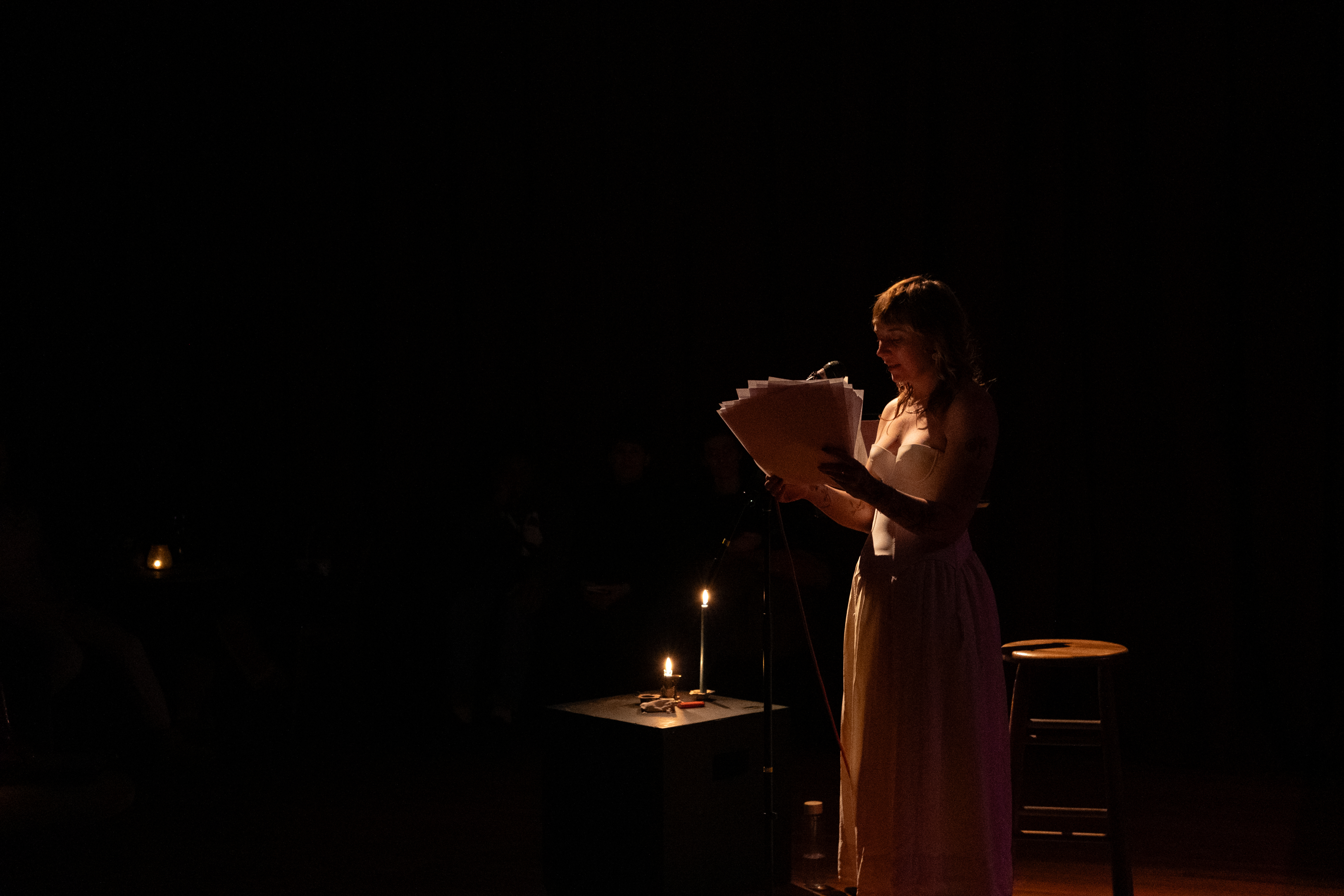
My sister, Frankie, went to the same arts school as I did. She also studied creative writing. I haven’t asked her directly, but I am pretty sure she would not call herself a writer. I don’t think she’s ever aspired to be famous, to go on book tours, or to have her book reach The New York Times bestseller list. She’s an art teacher now, but she’s been a nanny, a weaver, and worked on goat and flower farms. She’s a genuine, true spirit. When we were little, we used to practice Nin-Jitsu, and the sensei at our Dojo said, “With most people, you have to work to get them to think outside the box. With Frankie, there is no box.”
Despite her varied career and life trajectory, my sister has been taking a poetry class once a week for over 5 years now. She goes through periods where she writes a poem a day. My sister creates so much art. Sometimes she shares it. Mostly, she doesn’t. But when she does share it, she just shares it. Without self-consciousness or pretension. She and her friends hosted a winter solstice poetry reading in Baltimore last December because they wanted to. She’s not worried about what it all means: is she a writer? Is she an artist? Is she real? She just lives. She doesn’t have a ton of extra time to write, so she just writes when she can. She reads when she can. She paints and makes comics when she can. But ultimately, those little moments of art compound to create a long life filled with art.
And, she happens to be a truly gifted poet! But I think a lot of her power comes from her refusal to put her life, or her work, in a box.
If you’re one of the 6,000 folks graduating from an MFA this year and you want to be famous and get rich like Jessica Knoll, by all means, go for it. There are definitely people out there who make it, like Caro Claire Burke, who graduated from Bennington and has a book and a movie deal for her first book.
There are people who will teach you how to make a living from your creative work like Cody Cook-Parrot. I’m just not sure that’s for me. Of course, I have publishing desires. I still want a European book tour. All expenses paid by Penguin! But that’s more of a fun fantasy, not an actual desire I have for daily life.
TL:DR
But in all seriousness, I do think there is something else inside us that makes us want to write, and that something imbues our art with a real flavor, a sensation, and it can be experienced by those who witness our work.
And so, together, even with just two people, we can, for a moment, transcend separateness. That’s what art is for. And you can’t put a price on that.


