


STOP!
THIS IS BETTER ON AUDIO!
SCROLL UP AND CLICK PLAY ❤️

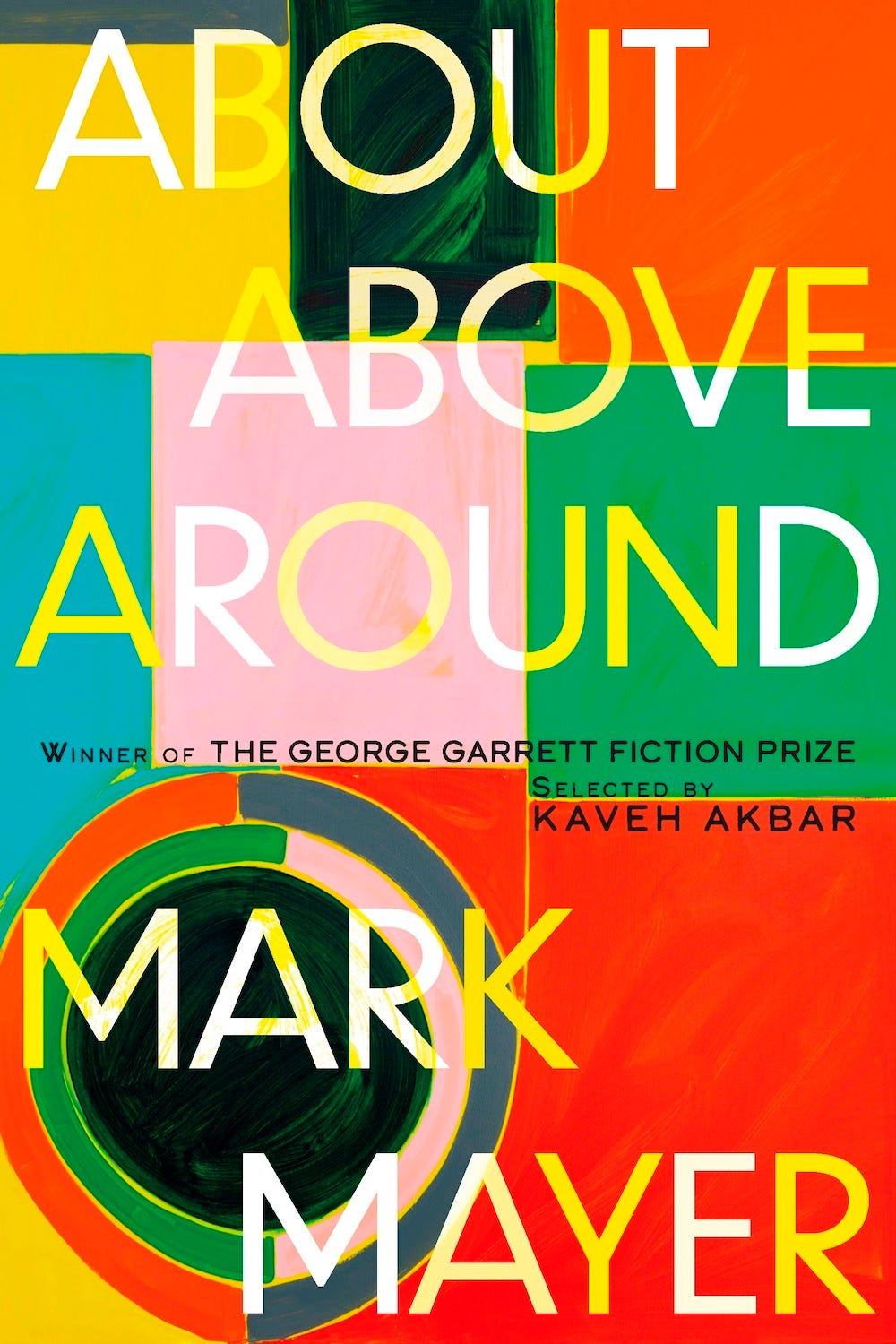
Before we get into it, I wanted to let you all know that Mark Mayer, a talented writer I have had the privilege to work with, has a new book y’all can order!
Kaveh Akbar (author of Martyr!), selecting the collection for the George Garrett Prize, says: “About, Above, Around is thrillingly ambitious and deliciously readable, a remarkable vortex of place and mind and spirit illuminating how our lives are shaped, and how we’re held within them. Mayer has given us one of the most dexterous, impressive books I’ve read in ages.”
Without further ado….
The Work of Art Part 3: Gonna Make you Notice
A reminder that this is a series of essays about the work of art: the labor behind making art and what art does and does not reveal about this labor.
As I said in the Work of Art Part 1: I think there are two main reasons a writer seeks publication:
Financial gain
Validation/attention
We’ve already talked about money. Now let’s talk about validation and/or attention. This is a pretty negative way to talk about this desire. I could use more optimistic and favorable language to suggest that there is a more altruistic reason for wanting to expand the world with your art: the desire to connect with people through your stories in a way that benefits and deepens our understanding of this life we live. But altruistic reasons will probably always contain shades of self-interest.
I can only speak for myself, but for me, I want to publish for attention and validation. I wrote When Darcy Met Lizzy as a fun project, something I wrote for my partner, because I wanted her to relate to a book that I deeply admired and loved. As a queer, Brazilian woman, 19th-century British literature felt completely beyond her frame of reference, and so I made it into a kind of game. Could I make Darcy and Lizzy transcend the confines of a novel of manners and speak to modern fears and desires? Could I make Regency England fun for a woman who thinks monarchy and colonialism should stay a thing of the past (rightly so)?
It could have been a private book I shared only with my partner and a few friends. Instead, not even a few months after finishing the book, I was already seeking agents and publishers for the book. I quickly came to my senses and realized that such a close retelling of Pride and Prejudice would never find a home at any traditional publishing house. So I decided to self-publish the book.
What made me want to publish something that I’d created for fun in the first place? Why turn something private into something public?
Because writing is a lot of work. It’s enjoyable sometimes, yes, but it takes hours, months, years of your life to create a finished product. And while you’re working, there are countless hours of self-doubt, frustration, and struggle. And the time I spent writing was time I was not going on hikes, not sailing, not seeing friends, not spending time with my partner or our dog. There’s an opportunity cost to writing. When you are devoted to writing you miss out on a lot of life.
Once, someone tried to tell me that they had worked harder in their life than I had because they spent more time working at their day job and had devoted their life to their work, while I hadn’t been as dedicated to my career. The implication was that because I have had an inconsistent job history and have worked in lodges and restaurants longer than most of my peers in tech, I am lazy or less hardworking. I bristled at the statement. I felt deeply unseen.
Because I love to write and because it feels like a calling from a higher power (be it art itself, the universe, God, who knows?), I think there’s a tendency for people on the outside looking in to view it as a hobby, as something I do on the side, the way people watch birds or fly fish on the weekends. On a flight to Greece this summer, I sat next to a woman who asked me why I was traveling. I told her I was going for an artist residency. She asked me what art I practiced, and I said writing.
“Oh!” she said, excited. “What have you written? Where can I buy your book?”
Eventually, we got around to the truth that my art does not generate money; in fact, it has only generated debt.
This well-intentioned woman sipped her prosecco and said, “Well, it’s nice that you have a hobby.”
Work, Value, and Time
Why do we reserve the term artist for people who make money from their work? Why is a musician only entitled to call themselves a musician if they make their money from concerts and album sales? Why is a writer only a writer if they have a job teaching at an MFA program or cobble together an income from freelance articles and book sales?
This is because of the Labor Theory of Value, which can be boiled down to the sentiment that time is money. And if we spend our time working on something that does not generate money, it inherently lacks value. We value lawyers and doctors who work long hours, but our culture does not value individuals who dedicate their time to unpaid work. This comes up a lot with mothers. Our capitalist system would not run without the unpaid labor of women. And yet mothers who stay at home to care for their children, performing an essential element of the capitalist system, often struggle with feeling invisible, worthless, or like they’ve lost their identity. Because, even though their work is essential, it’s invisible and, more importantly, unpaid. Their time is not exchanged for value. (For more in-depth discussion of this, read Work Won’t Love You Back by Sarah Jaffe or Caliban and the Witch by Silvia Federici).
Not to get all Malcom Gladwell on you, but I have definitely put 10,000 hours of effort into my writing. When I was in the first grade, I did a little project on how I wanted to be an author when I grew up. For middle and high school, I attended an arts magnet school in Denver, where I spent an hour and a half each day surrounded by other young writers. I wrote in college, where I was a creative writing major, and I have taken numerous workshops over the last fifteen years since graduating, not to mention the countless hours I spent writing alone in coffee shops, on my mother’s couch, and alone in my apartment.
This probably all comes across as a little defensive and bitter to you. It should! I am being defensive and bitter!
If I were truly secure in my own worth, I don’t think it would have bothered me so much to hear someone else claim that they worked harder in their life than I did. I cannot deny that this person worked harder at their paid job than I did, but when it comes to writing, the work of my life, I know I have given it, if not my all, quite a lot.
But what happens when all that work is invisible? What happens when, every day, people dismiss something that you strive to be the very best at as insignificant, or as a way to pass free time or to stave off boredom? As I said, if I were a confident, self-assured person, it wouldn’t bother me so much! I would be able to write and be satisfied with my own progress. I can look at the short stories I wrote ten years ago and compare them to my writing now, and see significant improvements in craft, so why should I care if anyone else notices it too?
I care for a few reasons. One reason is I want to feel loved and safe. I think Chloe Zhao, director of Nomadland and Hamnet, says it best in her interview with David Marchese:
So many of us started telling stories because we didn’t have the easiest childhood. So when your work, which is the only way that you can seek connection and validation since you were a child, is being compared and judged, you could go as far as feeling that a rejection of that work is a rejection of who you are and your ability to be safe or loved.
The other reason I care is because we live in a society where what we produce, and how much, determines not only our financial value, but something else just as important. By day, I work in the tech industry, and in tech, working 15 hours a day and not having work-life balance is not only encouraged, but glorified. If you’re only getting five hours of sleep at night but still producing features, code, products, etc… you’re a hero. But it’s not just tech–it’s the way our capitalist system is designed.
You are your time.
Your time is what you give to work. This labor time is exchanged for money.
This money generates value.
So what to do with all this work of writing? Does it have any value?
Writing When Darcy Met Lizzy, I spent hours every night working. It was a solitary endeavour. It was for me and me alone. But if I didn’t share my writing, all that work, all that effort, it had no value in society. And we are programmed to think that our effort is only worthwhile if it has value.
I wanted to put the book out there to prove to anyone who might listen that I am a hard worker, I am devoted, I am masochistic in the service of labor. You might not see me, reader, but here I am, a workaholic, just like the rest of you! I have worked my whole life to get better at one thing! Validate me! The more people who bought or read my book, the more value I would accrue. The more people would see me for who I really am.
I wasn’t looking for financial value but social value.
Status, Identity, and Value
Once, I asked a Canadian artist friend if she ever felt it was hard to be in relationships with people who didn’t share her views on capitalism. She laughed as if I were absurd. She said, “I think that is a distinctly American problem.”
“We must consider a rather serious paradox: though American society is more mobile than Europe’s, it is easier to cut across social and occupational lines there than it is here. This has something to do, I think, with the problem of status in American life. Where everyone has status, it is also perfectly possible, after all, that one has. It seems inevitable, in any case, that a man may become uneasy as to just what status is.
But Europeans have lived with the idea of status for a long time. A man can be as proud of being a good waiter as of being a good actor, and, in neither case, feel threatened. And this means that the actor and the waiter can have a freer and more genuinely friendly relationship in Europe than they are likely to have here. The waiter does not feel, with obscure resentment, that the actor has ‘made-it,’ and the actor is not tormented by the fear that he may find himself, tomorrow, once again a waiter.
This lack of what may roughly be called social paranoia causes the American writer in Europe to feel, almost certainly for the first time in his life, that he can reach out to everyone, that he is accessible to everyone and open to everything. This is an extraordinary feeling. He feels, so to speak, his own weight, his own value.”
Because we live in a society predicated on the idea that any man can “pull himself up by his bootstraps and make something of himself,” we live, as Baldwin suggests, in a state of social paranoia.
To be continued next week…


