


💖 STOP! THIS IS BETTER ON AUDIO! SCROLL UP AND CLICK PLAY
THERE IS MORE IN THE AUDIO VERSION THAN THE PRINT VERSION 💖
This is a series of essays about the work of art: the labor behind making art and what art does and does not reveal about this labor.
It’s best to start at the beginning:
The Work of Art Part 6: The Artist and Instagram, a love story, i.e., an unrequited co-dependent relationship that ends with you on the bathroom floor, a husk of a human, having given all of yourself to be loved, respected, or seen, and Mark Zuckerberg, happy, satisfied, gorging on the fat profits he made from your obsessive desire.
In 2026, the world would have you believe that if you want to promote your art, there is only one way. New poem published? Link to it in a story! We’re told that if you post a photo of your face, Instagram’s mysterious algorithms will pick it up and show it more on people’s feeds. Let that word sink in: feeds. It’s funny, that’s the word my dad, who was houseless for nearly twenty years, used to describe the meals served at churches for the unhoused population. He’d say, “I run into so and so sometimes, at the feeds,” or “I can’t be late for the feed.” Feed is also what we call the food we give to livestock. Chicken feed. There’s something in that term that implies excessive starvation finally satiated. To feed another human is primal and nurturing. What does a mother do for her crying child? She feeds him with her body. What do you do when you seek absolution at church? You are fed with the body and blood of Christ.
But what does it mean to offer your body, your art, to a feed? And what does it mean to manically seek a feed compulsively, in the bathroom, at the table, on the couch with your lover as you watch a movie, before you go to bed, until your eyes glow blue long after they’ve closed? It’s like that scene in Spirited Away when Chihiro’s parents see a buffet of free food and start gorging themselves on it, not realizing that as they stuff their faces, they’re transformed into pigs until they forget their own names.
To help offset the upfront costs of When Darcy Met Lizzy, I decided to launch a Kickstarter campaign. With Kickstarters, you must meet the entire fundraising goal or you don’t get any money. My first Kickstarter failed. I wanted to raise eight thousand dollars (which was less than the book ended up costing, more on that later), but it didn’t get enough supporters. So, I created another Kickstarter with a much more modest goal of $3,000. I promoted my Kickstarter on Instagram relentlessly. I even made a TikTok! I also paid Instagram and TikTok to promote my book posts. Not much, but in the end, I spent around 200 dollars on ads. According to TikTok, my promoted videos were getting thousands of views.
💖YOU ARE MISSING OUT IF YOU’RE NOT LISTENING TO THIS NEWSLETTER 💖
SCROLL UP!
Because I was constantly posting, commenting, responding, and sharing, I was on my phone all the time. When I had alone time at the house, I was trying to record videos that I thought might be funny, or, because I am not very funny, at least a little informative. The more time I spent on my phone, the more I couldn’t put it down. My girlfriend and I were moving at the time, and I spent so much of that month on my phone, and we got into more than one scuffle about my inattention to our move and my devotion to my phone.
Queue the Empire Strikes Back, Yoda’s Hut “never his mind on where he was, what he was doing.”
The more time I spent on Instagram, the more I started to compare myself to other writers who were more talented, more successful, prettier, and cooler. And the worse I felt, the more I started to get sucked into strange compulsive purchases. I bought a Pura air diffuser because I wanted our house to smell like you were actually in a mystical cedar forest and not a cul-de-sac in Olympia! I bought art on various cheap sites to make our house feel like “home,” and in the end, they weren’t that cheap, but they looked cheap. I bought a lot of books by people I thought I was supposed to read. The more time I spent on Instagram to raise money, the more money I mindlessly spent.
In the end, my Kickstarter raised $4,500 dollars, more than my goal. I sold over 100 copies of my book. This is not a jaw-dropping amount, but it felt good. At least my project hadn’t failed a second time!
At the end of the campaign, I checked the stats that Kickstarter provided and was astonished to discover that fewer than 15 of the people who bought the book were people I personally knew or am connected to through Instagram. At first, I was devastated. Aside from a few distant acquaintances, the only people I knew who bought my book were my closest family members and a tiny number of my dearest, lifelong friends. This means that not even good friends bought the book. Like people I saw daily during different times in my life. I felt humiliated and embarrassed. All that posting on Instagram and people who I knew from my hometown of Denver, from my new home in Olympia, friends from Portland, friends I thought would support me, hadn’t. In the end, posting every few days on Instagram hadn’t resulted in real friends, let alone my Instagram “friends” buying my book. All that time, energy, and effort had resulted in absolutely nothing.
So how had I made so much money and sold so many books? Kickstarter chose this project as a Project We Love, and it was featured in a newsletter sent to its subscribers (I didn’t realize it at the time). This newsletter generated a lot of sales. Of the 104 backers, 2 came from Instagram, 2 from Substack, a few from a direct link, and the rest from a combination of the Kickstarter App, the Kickstarter homepage, the Kickstarter discovery tool, and the newsletter. So basically, Kickstarter saved the day.
When I complained to my friend about this, she said I should be flattered that it was complete strangers who supported me because it meant that people didn’t buy the book out of obligation. But I still had this sensation that I was standing in front of an audience without clothes, butt naked. I couldn’t shake the feeling of shame.
Posting on Instagram is a humiliating endeavor. Some people manage to remain authentic, and more power to them, but I definitely didn’t. I was 100% performative; recording videos when I felt I looked particularly pretty, or when I liked my outfit, or the light through the window. The Kickstarter stats made me feel like all my stories and selfies were not only vain but ineffective. It’s like a bad ’80s movie where the girl gets all dressed up, but nobody shows up to take her to the prom. I also had this intense feeling that I’d sacrificed something to Instagram, that I’d given something of myself to a digital beast, and I’d been devoured, marrow and all, and I was less of a person now because of the exchange.
This sensation of powerlessness and shame I felt is not dissimilar to what an addict feels. The first step in any twelve-step program is “We admitted we were powerless over the effects of (insert addiction here) and that our lives had become unmanageable.”
And that’s precisely what I felt, that my life had become unmanageable. That I was powerless. And this is no accident.
Sean Parker, the first president of Facebook, said:
“We need to sort of give you a little dopamine hit every once in a while, because someone liked or commented on a photo or a post or whatever.… It’s a social-validation feedback loop … exactly the kind of thing that a hacker like myself would come up with, because you’re exploiting a vulnerability in human psychology.… The inventors, creators—it’s me, it’s Mark [Zuckerberg], it’s Kevin Systrom on Instagram, it’s all of these people—understood this consciously. And we did it anyway … it literally changes your relationship with society, with each other.… It probably interferes with productivity in weird ways. God only knows what it’s doing to our children’s brains.”
I’d argue that we have all become addicts, to some degree or another, through the intentional design of “the men behind the curtain.”
p.s. I wrote this last October, but since then, there have been more and more interviews, books, and research that agree.
Here’s one of many:
It’s not an anomaly that we feel anxious and unsettled and can’t be in a different room than our phone, or that our homes are filled with stuff we’re not entirely sure why we bought in the first place. It’s no coincidence that when I sit down for dinner with some of my best friends, they check their phones every 3 to 5 minutes, as if there’s an Amber Alert. It’s compulsive and distracting. This is not an accident. They did this on purpose. We’ve been the subjects of mass behavior modification.
My Kickstarter is a microscopic case study and not nearly extensive enough to be considered applicable to the general masses. I’m sure there are people out there, famous people, who post on Instagram and see a dramatic uptick in sales, or podcasts downloads, or spotify pre-sales, but if you’re just a regular, everyday person like me, I think my experience will probably apply. I doubt anything you do on social media makes much difference in how many people actually engage with your art. Of course, there are exceptions. But sometimes those exceptions aren’t very fun either.
So why does it feel wrong not to be on Instagram sharing your latest Substack with the world? How will anybody hear your voice?! If a tree falls in the woods, will anyone listen?
I’d argue that:
Even if people are standing in the woods with you, not very many people listen anyway, even if you’re famous.
Promoting your work on Instagram actively detracts from what you’re trying to gain from the promotion in the first place, like time and attention.
We’ve become a world of addicts who shame and judge fentanyl addicts on the street corner, but partake in our own drug with witless abandon, to our own undoing. We have created a shame cycle of judgment and lack of personal accountability that feeds into a system that is oppressing us.
💖 THERE IS EXTRA SHIT IN THE AUDIO 💖
SCROLL UP TO LISTEN!
The War for Your Attention
My sister recently started dating someone, and she’s super excited about them, and I am super happy for her. She sent me a YouTube interview with her sweetie and asked me to watch. If you know me, you know that there is probably one person on planet earth that I would do literally anything for, and that’s my baby sister. Also, I am super nosy and judgmental, so of course, I couldn’t wait to see if her sweetie was deserving of my sister. And yet, days went by. Weeks went by. Over a month and a half elapsed between when my sister sent me the interview and when I actually watched it. To be clear, this interview had the secret sauce for attention:
Motivation: I wanted to see if my sister was dating someone worthy of her.
Devotion: I love my sister and want her to feel supported.
Interest: the subject matter of the interview was something I studied in school, so I was actually super intrigued.
So why did I only watch the video after months of procrastination and only out of a deep sense of moral obligation?
I’ll give you another example. I subscribe to the literary magazine Brick. I think it’s a cool magazine. I love the work they publish. They published an essay by the writer Anne de Marcken. She lives in Olympia, and I did a reading with her in Port Townsend a while ago. I think she’s amazing. I was intrigued by the subject matter. Again, this piece has all the magic to garner my attention—access, desire, and interest. And yet, it took me 7 months, yes, you read that right, 7 months, to read that essay.
The point of all this is: I don’t even give my attention to the work that most interests me and that I have the strongest motivation to observe.
So where the fuck is my attention going?
As someone who works in tech, I straddle two worlds, so I am fortunate enough to at least understand the massive forces designed to steal our attention.
To sum up Jaron Lanier’s book Ten Arguments for Deleting Your Social Media Right Now (written by someone much smarter than me about work I personally know a lot about):
Meta and Google, and Amazon (not AWS, although, yes, AWS indirectly if you think about the fact that it’s where a lot of these apps are built, but I digress) make money from YOU.
They make their profits from your attention.
YOUR TIME is making Mark Zuckerberg rich.
Let me break it down for you:
Whenever you use Instagram, the app logs your attention. It’s trying to keep you engaged long enough for you to view advertisements, because it’s those companies that pay Meta for your time. Meta gets rich off Babaa, who keeps promoting you that super cute sweater. Ideally, Meta wants you to see an advertisement 7 times because that’s when you’re most likely to pull the trigger and buy the product. So, how does Meta keep you on Instagram so that the company that purchased the ad gets a conversion (a conversion means that a view is converted to a purchase)? Meta appeals to your dopamine. I’ll get into this more next week, but the things that tend to keep you engaged longer are the ones that make you feel bad. But not bad all the time. Just bad enough. And sporadically bad, so you never know what to expect. The key is that they must keep you laughing with those silly reels about golden retrievers, and then bam! Post something that gets under your skin when you least expect it. And then, you don’t want that bad feeling in your body anymore, so you keep scrolling, hoping for more dog reels.
So not only are you giving your time and attention away so that you can spend your money, which you spent more time and attention to earn, on some product, you are giving your time and attention away to feel bad.
If I went up to you and said, “In exchange for approximately 5–6 hours a day feeling shitty, you will spend $50,” would anyone in their right mind take that deal? No one would. Because it’s not a deal. It’s a loss.
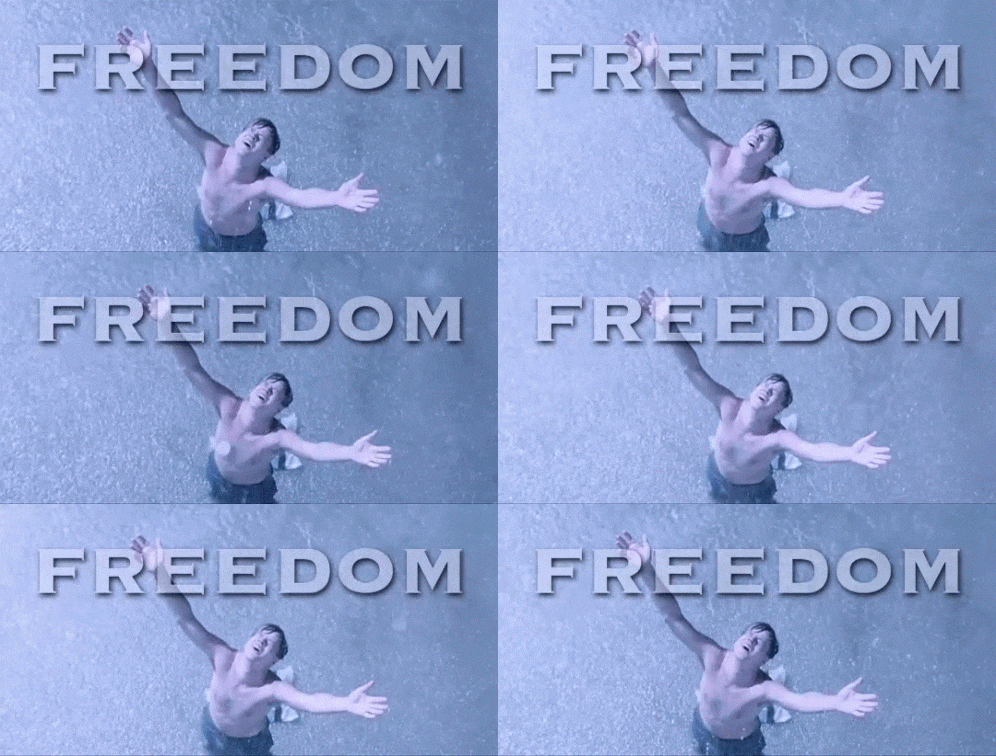
According to James Marriott, a recent article in The Times found that, on average, modern students are destined to spend 25 years of their waking lives scrolling on screens. 25 years! That’s almost as much time as Andy Dufresne spent in Shawshank! But we’re doing this to ourselves!
💖 STUDIES SHOW THAT 90% OF YOU HAVEN’T MADE IT THIS FAR
BECAUSE SOCIAL MEDIA HAS DESTROYED YOUR ABILITY TO READ
BUT IF YOU HAVE, THERE IS BONUS CONTENT IN THE AUDIO
SCROLL UP TO LISTEN!💖
I am already giving at least 40 hours a week of my attention to a boss; why in the world would I willingly give my spare attention to companies that are going to steal that attention and try to get me to waste my hard-earned labor time?
Lanier says it more strongly than I:
“Yes, being able to quit is a privilege; many genuinely can’t. But if you have the latitude to quit and don’t, you are not supporting the less fortunate; you are only reinforcing the system in which many people are trapped. I am living proof that you can have a public life in media without social media accounts. Those of us with options must explore those options or they will remain only theoretical. Business follows money, so we who have options have power and responsibility. You, you, you have the affirmative responsibility to invent and demonstrate ways to live without the crap that is destroying society. Quitting is the only way, for now, to learn what can replace our grand mistake.”
And if Lanier didn’t persuade you, let me put it another way.
As artists, we are told we must go to Instagram to promote our pride and joy, our creation, our little art baby. We want to promote our art for either money or attention. But money is really nothing; it’s just a piece of paper or an imaginary number in your bank account. Money’s true self is time. The more money you have, the more time you have. And isn’t that why we’re promoting our work in the first place? So that we can exchange the piece of work we loved making, that took so much fucking time and energy, for more time, and the possibility to continue giving our energy and attention to what we love?
But in the process of trying to get more time, we spend our time in a place that’s designed to make us feel really, really bad to prompt us to use the money we’re fighting so hard for on things we don’t really need or want in the first place.
And, more than likely, we end up addicted to the point that we experience pain and anxiety when we’re not using and have trouble focusing on the art we wanted to create in the first place.
So why trade your time, your attention, these precious and limited treasures, away in a gamble for something that will ultimately rob you of both?
TL:DR :
Time is, for the working class, our economic power.
Corporations are trying to buy our “leisure time” and our attention so we enrich them.
Time spent on Instagram bankrupts us of our real time in the present, our working time (our labor), and the love that is available for us in our attention.
p.s. I haven’t read Cody Cook-Parrot’s book, The Practice of Attention, yet, but I am sure it says everything you need to know about art and attention and more!


