
*song in the podcast version is Don’t Dream It’s Over, a cover by Sylvan Esso and Flock of Dimes

A few years ago, my sister invited me to visit her in Georgia, where she lived on a flower farm with a cat named Blue. To get there, I took a Southwest flight, and I was late to check in, so I was subjected to boarding Group C. Middle seats for me. But as I boarded the flight, I could see an exit row with an empty seat. On this aircraft, the exit row has only two seats instead of three, with a large empty space near the window. After nearly everyone had boarded the plane, how was this seat vacant? How could I possibly have been that lucky?! I looked at the man sitting next to the open seat. He had a long white beard that fell to his lap. His hands were laced over his rotund belly. His beard touched his belt buckle, and his long white hair draped both sides of his stocky, flannel shirt-covered frame. Aside from the fact that he was a large man and therefore left the seat next to him a little cramped, I suspected the real reason the seat was empty was that both his red baseball cap and flannel shirt screamed, “Make America Great Again.” Was the extra space worth sitting next to a MAGA supporter who probably thinks trans people aren’t real or that gay people should be stoned, I wondered (if you think I am exaggerating, see Charlie Kirk saying these things and more)?
But I decided that the extra space was worth almost anything.
As the plane began to taxi, the man turned to me and asked me why I was flying to Atlanta.
I hate talking on planes. For the love of God, all I want is some peace and quiet. Please don’t talk to me for the next two and a half hours!
To see my sister, I said. What about you?
I’m going to a Santa Claus convention, he said, and then began to tell me about his job.
He is Santa Claus, and he takes it seriously. He pointed to his hat, the red one that I assumed was a MAGA hat but never actually bothered to read. Stitched in silvery thread, his hat said: “Saint Nicholas Institute,” which he attended a few years ago to better understand the spirit of the saint Santa Claus was created to represent.
The man I had moments before considered to be filled with hate and vitriol was actually a 70-year-old Santa nerd. He excitedly told me about the folklore he’d created to liven up Santa’s world for the kids. As the lights in the cabin dimmed, he recited to me, from memory, “The Night Before Christmas,” but the Frozen version.
It was the night before Christmas and all through the castle… He serenaded me with the whole poem.
By the end of the flight, it was not April, and I was not in a 747 flying over Texas; I was in a fantasy childhood where my grandfather had me on his knee on Christmas Eve, and I was safe with the knowledge that I am cherished and loved, and that come morning, there would be gifts, and there would be merriment, and there would be joy!
Finally, he leaned forward and conspiratorially asked me if I thought coal was good or bad. As he asked, I saw him pull out a green velvet drawstring pouch from his pocket. I was thinking about coal and the environment, and immediately responded Bad. He smiled and handed me the little bag.
Open it, he said, like a little boy eager to see my reaction. I poured the contents of the bag into my palm. It was a tiny little black piece of coal.
What, he asked, happens to coal with patience, pressure, and time?
I smiled. It becomes a diamond.
That’s right, he said, and tapped my hand. I tell the kids, even the thing that feels like it’s the worst gift in your stocking, with patience, pressure, and time, will become something beautiful.
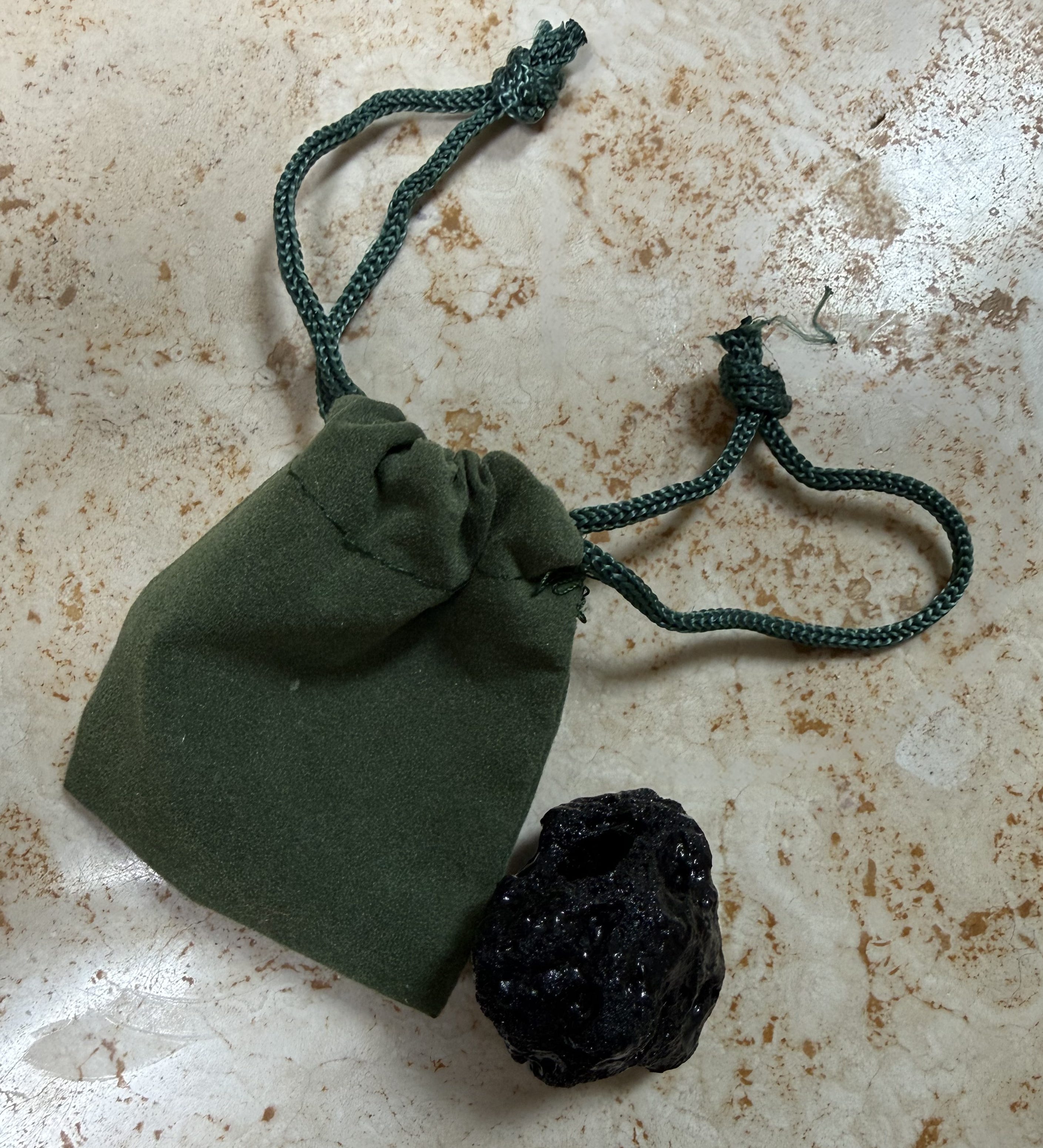
I still have the coal that Santa Claus gave me, and I think about it a lot. Making art in the world of capitalism can feel like a shit bag sometimes. You can feel like you’re struggling in a sea of bad jobs, a harsh economy with social policies that favor the rich, so what’s the point?
In The Work of Art Part 8, I said that I believe art, when shared, is how we can transcend separateness between two people. But I also think art can help you embrace your connectedness even when it is not shared. For example, I wrote a memoir in 2020. I have been revising this memoir for five years. I’ve sent it to agents and editors and contests, and each time it’s been rejected, I’ve taken a hard look at it again and revised it. I used to want this book to be published so badly. And of course, I still do. It would be really nice to walk into Elliott Bay Book Company and see this book on the shelves. But I am no longer starving for that recognition for this book. I feel satisfied and at peace because, through the process of revising and sitting with this book over the course of 5 years, I have grown to love the younger me who exists within its pages, the slightly younger me who wrote it, and the me now, who has finished it. And through the intimacy of sitting with this piece, and working on it, and feeling through it, I know in my heart that I have done my duty by the idea. My work has served the art that needed to be released. This sounds kind of spiritual, but I feel strongly that there was some sort of artistic kernel born in me and that kernel needed to be expressed through the process of creating the book.
And I feel just as strongly that I no longer need to work on the book in the same way. It might be published, and it might not. At this moment, I don’t really care either way because writing the book made me feel connected to art, to myself, to the people I have loved and lost. And I feel so lucky to have experienced that transformation. It took patience through many a dark night of the soul (from both myself and the people who read the book several times—thank you, Alyse Knorr) and a lot of pressure to get it right, to do justice to the idea that wanted to speak. And it took time! The book I first sent out to agents is not nearly as good as it turned out to be, and I am so glad they all passed on it so I could get it to the place it is now.
P.S: Before and After the Book Deal by Courtney Maum also talks, in-depth, about the life of a working writer. Highly recommend!! But I think it’s worth mentioning that, while I don’t know her personally, Courtney Maum seems like a badass who is committed to the life of a writer and works really fucking hard. But! She makes it clear that you can work as a writer and make money too 💖.
Watch her interviews and subscribe to her Substack in general, but definitely do so if you think my whole "don’t write for money " thesis is depressing.

Money comes in handy down here, bub!
The truth is, we have very little time on this earth. And it’s a major fucking bummer that, in our modern-day capitalist system, most of us will spend the majority of that time working—not to provide for our families, not to enable our own freedom—but to enrich a limited few.
If you’re one of the lucky, privileged few who get to be your own boss (therefore a member of the capitalist class and not the proletariat) and your time and your work directly contribute to the well-being of your family (meaning the hours you spend at your desk directly translate to a paycheck that comes to you in full), and you can still make art, just know that you won the fucking lottery.
Click the link above if you want to read a stunning essay about work by my friend, the writer Jerry McGill:
“My belief is that the people who are against affirmative action must lack an empathy gene. Oh, if they could only roll a mile in my wheelchair.”
But if you’re not able to be your own boss, if your time is not your own, if you have to devote your hours to a corporation that profits from your time, then don’t be hard on yourself if you’re struggling to make art, be present with your family, and do well at your job that you’re dependent upon for health insurance and groceries. The odds are stacked against you! Don’t carry the shame and burden of feeling like you’re failing. Don’t give in to the narrative that if you’re not economically self-sufficient, you are lazy.
You’re alive, and you’re trying, and that’s beautiful!
The unfortunate truth is that I can't have my cake and eat it too. To make art, I must have the will to do it. I have to wake up early, many hours before my job, sit at my desk, and write.
I need to sit and write, not for money, not for publication, not for a paycheck, but for art itself.
It reminds me of a line in the stunning work of art by Charlotte Salomon, Life? or Theater?:
But I realized that this was not so easy. I realized that no heaven, no sun, no star could help me if I did not contribute by my own will. And then I realized that actually I still had no idea who I was. I was a corpse. And I expected life to love me now. I waited and came to the realization: what matters is not whether life loves us, but that we love life.
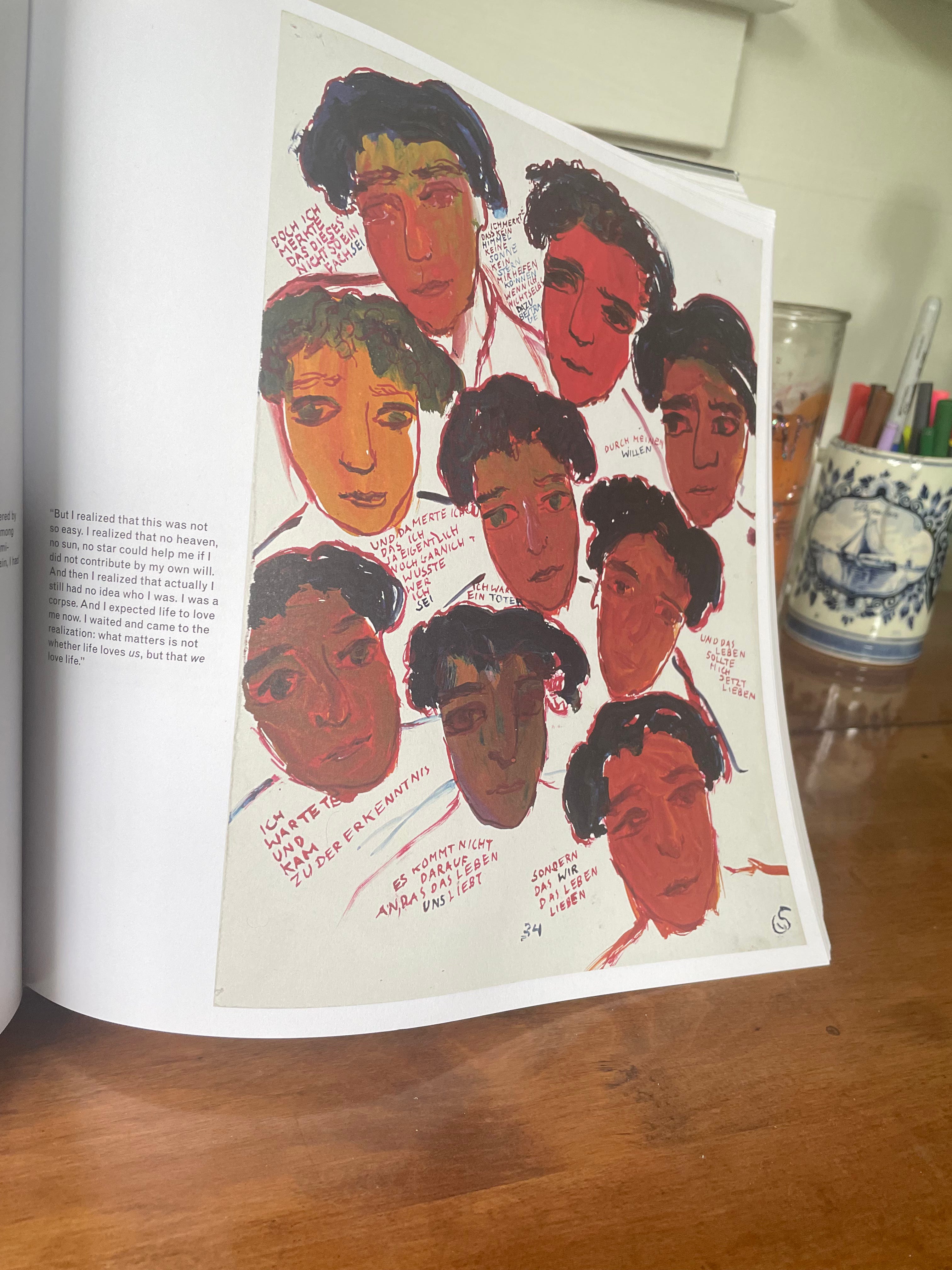
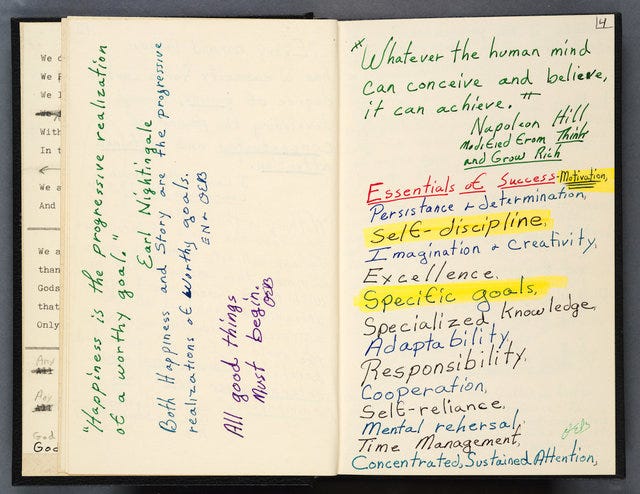
There is a certain freedom in knowing that our lives are truly our own, even within the constraints of modern-day life in capitalist America. Yes, I have to work. And yes, that’s a major bummer. But I can also choose what to do with the time that I have, and perhaps that time is made more precious by its scarcity. Toni Morrison didn’t publish her first novel until she was 39—she was too busy being a single mom and supporting her two children, and working! Octavia Butler worked at a factory, and yet she woke up at 2 in the morning to write.
Here’s Butler’s list of what makes a successful writer:
Even though I have the freedom to do what I want with the time that I have, as James Baldwin says, “nothing is more unbearable, once one has it, than freedom.”
This means that sometimes, after my workday ends, I will use my precious living hours to sit in my office and write. And other times, I will not work on my art, and instead choose to sit with my partner and our dog in our garden as dusk falls. Together we will smell the lilacs, listen to the chorus frogs, and watch the mourning doves dart between the trees.
With the freedom of my own life, I don’t choose to put my art and the dogged force of producing above my family, above these small spring moments.
In the end, don’t listen to me, listen to Gandalf when Frodo despairs at his situation.
“So do all who live to see such times. All you have to do is decide what to do with the time that was given to you.”

The diamond at the end of the road
This is corny, but I’m looking for corny in my life! The true work of art isn’t in the end result, even though that would be super nice. It’s in the patience and beauty that is found in carving out those five minutes to do what you love, amidst all that fucking pressure. And, over time, those five minutes, twenty, compound, and they create a life full of richness. Full of art. If we shift our attention to the everyday, to the practice of working on something for the sake of the work itself, I think we’ll find that every day will gain a new sacred flavor.
In the end, you, the artist, through time and patience, become the diamond. You are the gift you give to yourself.
I will leave you with this quote by George Saunders:
“Capitalism plunders the sensuality of the body,” wrote Terry Eagleton, and that was certainly true of my body at that time. It was being plundered of its sensuality every day. I had an engineering degree but was working as a tech writer. I had earned a reputation as the go-to guy where document covers were concerned. I was good at taping figures into place on frame sheets. I spent a lot of time at the photocopier, producing copies of the reports I had just edited, so we could send them to Kodak or the New York Department of Environmental Conservation, who, we suspected, often filed them without having read them. I was gaining weight, losing energy, had grown a consolation ponytail, would go home sore in my ankles and knees from walking what felt like miles on the thin carpeting that ran over our concrete floors.
There was a lot going on at home during those years, too. My wife, Paula, and I had gotten engaged after dating for three weeks. She became pregnant on the honeymoon, then went into labor at four months. She was put on total bed rest and required to take a drug (since outlawed by the FDA) to suppress her contractions. This happened again during her second pregnancy. So, while I was writing this book, we had two baby daughters at home, each made doubly precious by how close we’d come to losing her. We didn’t have any money and were into our thirties and were (maybe, just a little) wondering how it was that we’d missed the boat in terms of this thing called upward mobility.
At one point our second car broke and we couldn’t afford to replace it, so I started riding my bike the seven miles to and from work, along the Erie Canal. As winter approached, Paula put together an ad hoc winterproofing ensemble for me: a set of lab goggles, a rain poncho, some high rubber boots that, as I remember, had little spacemen on them. Biking along the canal I’d be composing in my head, and might arrive at work with a sentence or two all worked out. Then I’d dash through the atrium, into the men’s room, and try to get myself cleaned up, while not forgetting those sentences. Ah, those were the days.
But seriously: those were the days.
Biking back into town after dark, past the cozy colonial houses orange with firelight, I’d think: I have a home. I have people waiting for me, who love me. This is it. This is my life. These are the best years of my life.”